
Meta description: Class BA camping Wales 2026 explained: learn the 100m buffer zone, 60-day rule, prior approval, exclusions and campsite planning steps.
Hello, farmer, hospitality owner, or rural landowner.
Your Welsh land may support a temporary campsite.
Check the rules first.
Class BA camping Wales now provides a permitted development route for temporary recreational campsites. The rules changed in 2026.
You need to understand:
- The 60-day rule
- The 28-day limit
- The 100m buffer zone
- The annual prior approval process
- Environmental and heritage exclusions
- Campsite licensing
- Site access and waste controls
This guide explains the key points.
What is Class BA camping in Wales?
Class BA comes from the Town and Country Planning (General Permitted Development) (Amendment) (Wales) Order 2026.
The Order came into force on 1 June 2026.
The new operating route applies after the transition from 1 September 2026. Applications could be prepared from 1 June.
Class BA allows you to use land as a temporary recreational campsite.
It can support:
- Tent pitches
- Temporary camping areas
- Motorhomes and campervans, where allowed by the rules
- Temporary toilets
- Temporary wastewater facilities
- Temporary waste facilities
- Other moveable structures needed for the site
It does not give permission for permanent buildings.
You cannot assume it covers:
- Fixed shower blocks
- Cabins
- Lodges
- Glamping pods
- New roads
- Permanent hardstanding
- Permanent drainage
- New access works
Check each part of your proposal.
How many days can you operate?
The limit depends on your site location.
Up to 60 days
Most qualifying land in Wales can operate as a recreational campsite for up to 60 days in total in each calendar year.
The days do not need to run together.
Keep a dated operating log.
Record:
- Opening dates
- Closing dates
- Pitch numbers
- Guest bookings
- Maintenance days
- Any event dates
- Days when camping facilities remain available
A day can count even when no guest stays overnight.
Up to 28 days
The limit is 28 days in total in each calendar year if any part of the relevant land sits within:
- A National Park
- An Area of Outstanding Natural Beauty
- A World Heritage Site
Check the exact boundary.
Do not rely on a postcode alone.
Ask your local planning authority if the position is unclear.
The 100m buffer zone campsite Wales rule
The 100m buffer is the main Class BA site design issue.
Class BA does not permit campsite use on land within 100 metres of a protected dwelling.
A protected dwelling means a dwellinghouse or flat occupied by someone other than the campsite owner or operator.
This normally includes a neighbour’s home.
Your own home may not count as a protected dwelling if you own or operate the campsite. Check the facts for your site.
The rule applies to the campsite use.
Keep the following outside the 100m area:
- Tents
- Campervans
- Motorhomes
- Toilets
- Showers
- Waste facilities
- Wastewater facilities
- Reception areas
- Guest parking
- Campsite amenities
The private way exception is narrow.
An existing private way may pass through the buffer if you have a legal right to use it for access to or from your land.
Do not use that route as a pitch area.
Do not place campsite facilities along it.

How to map the 100m buffer
Map the buffer before you invest.
Follow these steps:
- Mark every nearby dwelling.
- Confirm who occupies each dwelling.
- Obtain an accurate site plan.
- Mark the relevant dwelling or property boundary.
- Draw the 100m buffer.
- Mark every proposed pitch.
- Mark toilets and wastewater facilities.
- Mark bins and waste storage.
- Mark parking and guest facilities.
- Mark any private access route.
- Remove every campsite element inside the buffer.
- Ask your planning authority to check the plan.
Use a scaled plan.
Show the measurements clearly.
Do not measure from a vague point on an online map.
Do not assume a hedge removes the rule.
Do not assume trees, slopes, or screening change the legal distance.
Screening can reduce visual impact.
It does not replace the buffer.
If the usable area is too small, consider another field or full planning permission.
Other Class BA exclusions
Class BA does not apply to every parcel of land.
The legislation excludes land including:
- Scheduled monuments
- Special Areas of Conservation
- Safety hazard areas
- Military explosives storage areas
- Sites of Special Scientific Interest
- Ramsar sites
- Sites of listed buildings
- Special Protection Areas
- Flood Zones 2 and 3
- Land within 100m of a protected dwelling
Class BA rights may also be removed by:
- An Article 4 Direction
- A planning condition
- Other local planning controls
Check these constraints early.
Use the Welsh Government temporary campsite guidance.
Check the Flood Map for Wales.
Ask your planning authority about local restrictions.
Annual prior approval campsite process
You must apply each calendar year before starting the campsite.
Submit an application to your local planning authority for a determination of whether prior approval is required.
The application covers:
- Toilet arrangements
- Wastewater arrangements
- Waste disposal
- Vehicular access
Use the Welsh Government prior approval form.
Attach a clear plan.
Show:
- Site boundaries
- Pitch locations
- Amenities
- Toilets
- Wastewater facilities
- Waste storage
- Access from the highway
- Proposed operating dates
- The 100m buffer
- Protected dwellings near the site
Submit the application before your first guest arrives.
The 28-day determination window
The local planning authority has 28 days to respond.
It may confirm that prior approval is not required.
It may notify you that prior approval is required.
It may also reject an incomplete application.
The authority must consider whether the proposal could create a material increase or material change in local traffic.
If the authority requires prior approval, provide the information requested.
Do not start the campsite until you receive written approval.
The prior approval process can assess:
- Highway safety
- Site access
- Traffic movement
- Queuing
- Visibility
- Toilet provision
- Wastewater storage
- Waste collection
- Pollution risk
- Nuisance to nearby land
The authority should decide the prior approval application within eight weeks.
Keep every document.
Save:
- The submitted form
- The site plan
- The submission date
- Payment evidence
- Council emails
- Written decisions
- Approved details
- Your operating day log
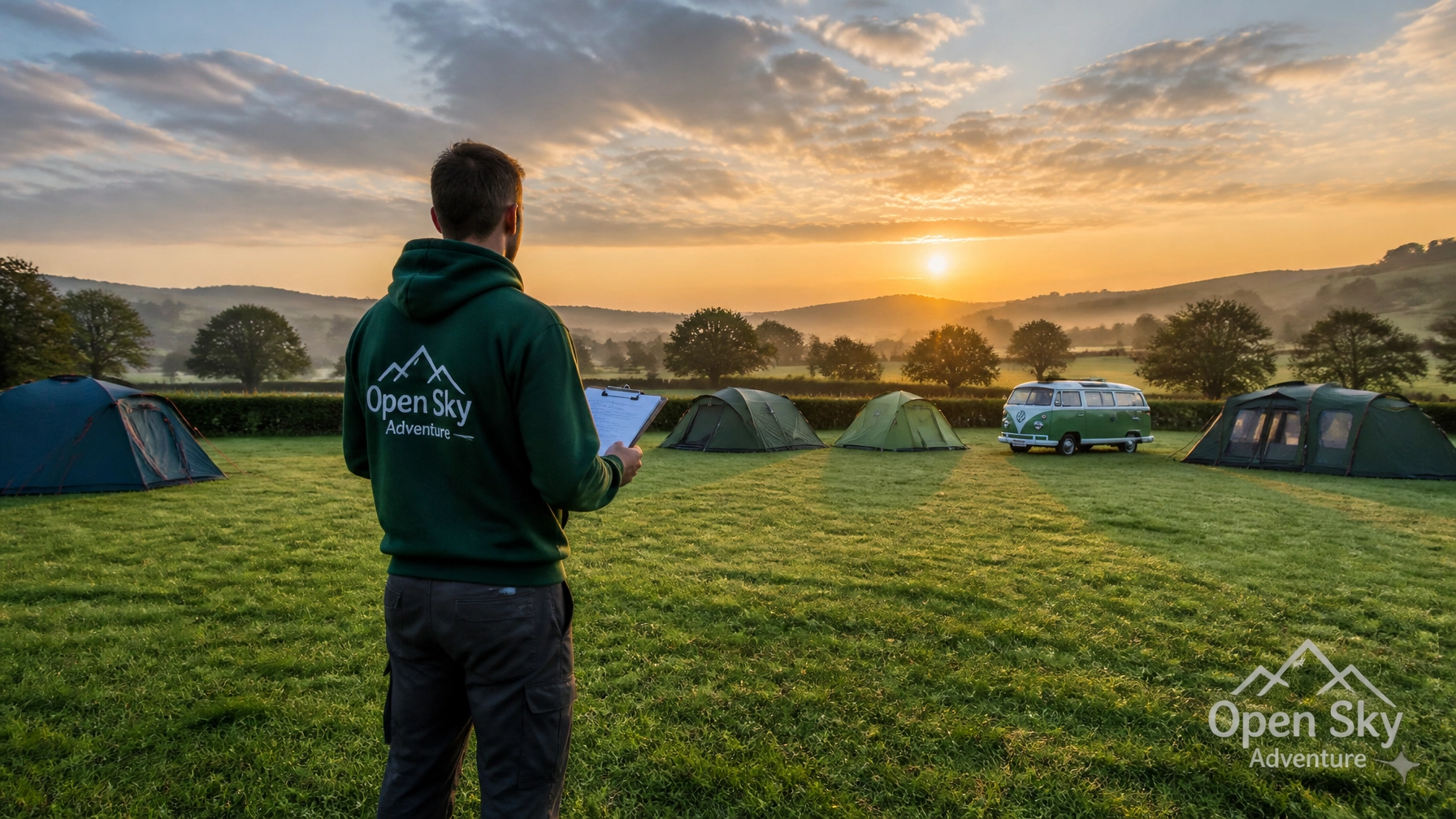
Design the site before you submit
Start with the land.
Place pitches:
- Outside the 100m buffer
- Away from flood risk
- Away from livestock
- Away from machinery
- Away from steep edges
- Away from water hazards
- Away from sensitive habitats
- Away from busy public rights of way
Plan a safe entrance.
Keep vehicles off the public highway while they wait.
Use clear entry and exit arrangements.
Separate vehicles and pedestrians where possible.
Show parking on the plan.
Plan toilets and wastewater before you advertise.
Use suitable storage.
Arrange lawful collection.
Do not discharge wastewater onto the land.
Do not rely on informal arrangements.
Planning permission is not the whole process
Class BA deals with permitted development rights.
It does not remove other legal duties.
Check:
- Campsite licensing
- Public liability insurance
- Fire safety
- Water supply
- Wastewater disposal
- Waste collection
- Electrical safety
- Food registration
- Wildlife protection
- Public rights of way
- Guest safety
- Outdoor activity risk assessments
Review the GOV.UK camping licence guidance for Wales.
Tent sites operating for more than 42 consecutive days, or more than 60 days in any 12-month period, may need a licence.
Caravans can follow separate rules.
Ask your local authority.
Do not confuse permitted development with a complete campsite licence.
Class BA checklist for landowners
Use this checklist.
Before investing
- Confirm the land is in Wales.
- Check the 60-day or 28-day limit.
- Map every protected dwelling.
- Draw the 100m buffer.
- Check protected landscapes.
- Check flood zones.
- Check environmental designations.
- Check heritage restrictions.
- Check Article 4 Directions.
- Speak to the planning authority.
- Speak to the licensing team.
- Check insurance requirements.
Before opening
- Draw a scaled site plan.
- Mark all pitches.
- Keep all campsite use outside the buffer.
- Mark private access routes.
- Provide toilet details.
- Provide wastewater details.
- Provide waste arrangements.
- Show highway access.
- List the operating dates.
- Submit the annual application.
- Wait for the decision.
- Keep written evidence.
- Record every operating day.
Use Open Sky Adventure for your next step
Class BA camping Wales can support farm diversification, rural tourism, pub income, hotel packages, and new outdoor experiences.
Start with the map.
Check the buffer.
Check the exclusions.
Prepare the prior approval information.
Plan safe access.
Arrange waste and wastewater controls.
Then decide whether your site should operate under Class BA or seek full planning permission.
Visit Open Sky Adventure to learn how landowners can create outdoor experiences with support, structure, and safety.
You can also learn how to unlock your land and potential or contact our team.
Join the group, sign up on the website, and send us your site location, land details, and plans.
We will happily help you, signup live now if you have an interest in joining our license agreement.
This article provides general information for 2026. It is not legal advice. Confirm the current position with your local planning authority, licensing team, and professional adviser before opening a campsite.